
CPSC Defense for Amazon and Marketplace Sellers
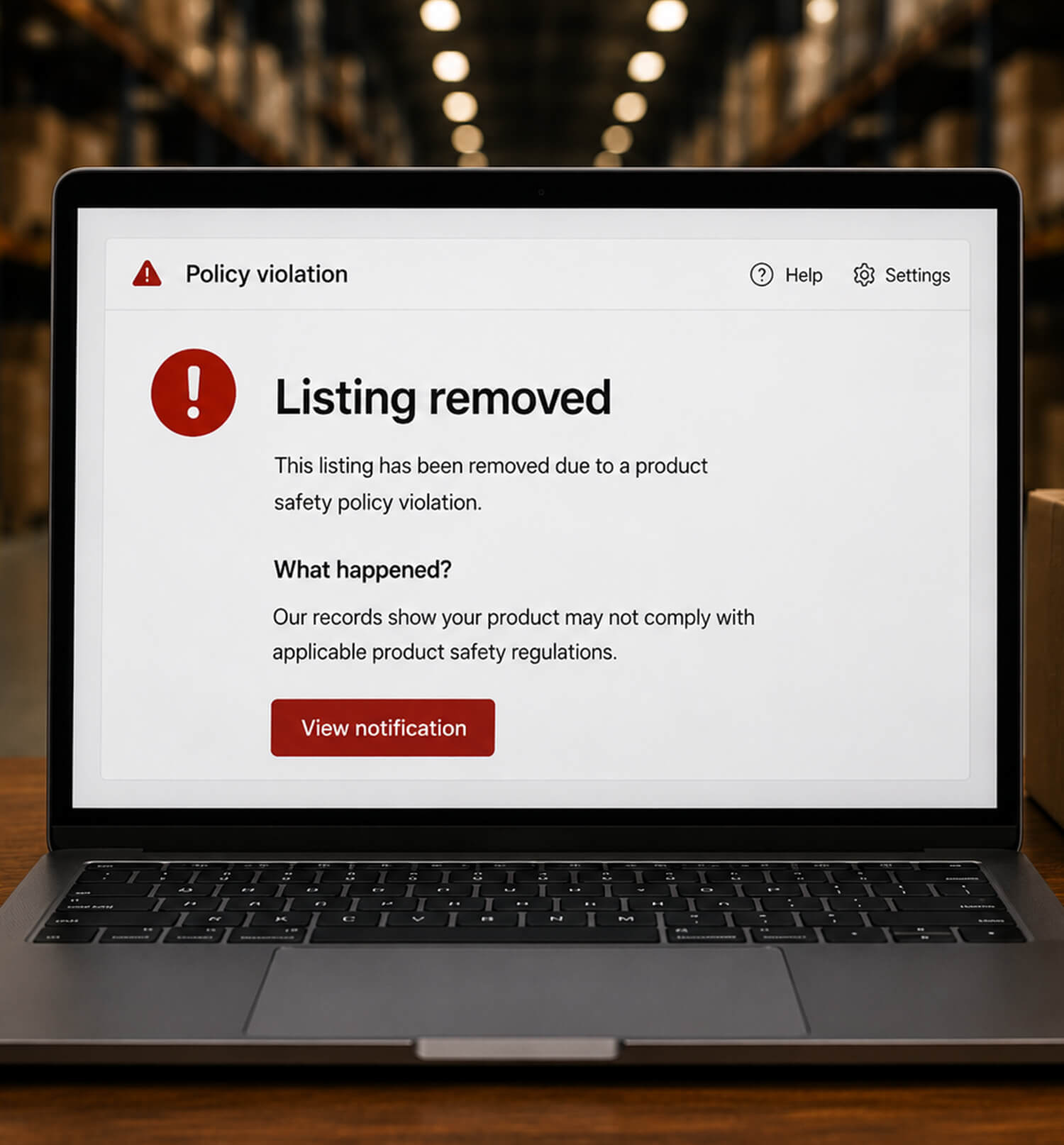
When CPSC has a regulatory or safety concern with your Amazon product, it will notify Amazon. Amazon can suppress an ASIN in minutes. Getting a listing back up when dealing with a CPSC issue can take months, costing you valuable sales and revenue.
We are former CPSC lawyers who can represent you on matters involving Amazon and other marketplaces. We identify what triggered the removal, build an effective case record for the platform and the agency, and work to fix your safety and regulatory problems to help get your listing and revenue back online.
Our lawyers worked inside the agency in high-level positions.
Handling CPSC matters every day.
We "speak" the marketplace language fluently. Whether it's Amazon, Walmart, Target, eBay, TikTok Shop, Wayfair, or another marketplace, we know what they need to hear to help restore your listing.
Your ASIN Was Removed.
Quick Action is Critical
Save the notice, case ID, and screenshots before anything is edited.
Do not file a generic plan of action or concede a defect.
Preserve test reports, certificates, supplier messages, complaints, and retention samples.
Put one person in charge of every outbound message.
Book a call before your first substantive written response.
Which of These Three Situations Are You In?
A platform problem only
Amazon wants documentation, or it matched your product to something that is not yours.
No agency involvement. May be correctable without involving a broader CPSC matter.
A platform problem on top of a real compliance gap
The marketplace action was triggered by an actual regulatory gap or violation. This must be addressed before it becomes a bigger legal and business problem, including the potential for Amazon to freeze your account funds and reserves.
A platform problem on top of an active CPSC matter
CPSC has issued a Notice of Violation or contacted the marketplace with a safety concern. Or, the facts may trigger Section 15(b) reporting. Reinstatement is now the smaller part of the problem.
A Takedown Today Can Become a CPSC Matter Tomorrow.
Marketplaces and retailers can have a CPSC reporting duty under Section 15(b) of the Consumer Product Safety Act.
- Platforms and retailers are risk averse and are quick to report to CPSC.
- Their report goes to the agency, not to you.
- If that report is filed, you may have a serious regulatory issue to resolve.
Taking control of the situation and protecting your company.
Why Delayed Reporting Matters
- The statutory duty may also reach individual directors, officers, and agents.
- These amounts adjust periodically for inflation.
- Criminal fines and penalties for both the firm and individuals may also apply.
Learn more on our 15(b) Letter page →
Why Amazon and Marketplace Sellers Hire Former CPSC Attorneys

Neal Cohen
- CPSC enforcement attorney
- Chief Counsel to the Director of the Office of Compliance
- The agency’s first Small Business Ombudsman, 2010 to 2016
- Created the CPSC Regulatory Robot, launched January 2016

Boaz Green
- Senior Counsel then Chief Counsel to a CPSC Commissioner, 2014 to 2018
- Commission-level review of enforcement and policy
- Previously practiced at Keller and Heckman
- Writes and speaks regularly on CPSC enforcement
Frequently Asked Questions for Amazon and Marketplace Sellers
Why did Amazon remove my listing for a product safety complaint when nobody was injured?
Injury is not the only trigger for a listing removal. A listing can come down over a potential violation of a mandatory safety rule, a missing or defective certificate, a cluster of negative customer reviews describing a safety hazard, another recall of a product that resembles your product, or direct CPSC contact with the platform.
Amazon says “do not attempt to relist this product.” Is that permanent?
Not necessarily. However, it means that you need to resolve this issue with the compliance team before trying to get your listing back up. This requires understanding and fully addressing the issue. With a large platform like Amazon, you may be asked to provide testing documentation, GCCs or CPCs, and even a written letter of assurance outlining why the product at issue is, in fact, either compliant with the regulations or does not have a potential safety issue.
My appeal keeps getting rejected with “not enough information to remove the violation.” What do I do now?
That message usually means the submission did not provide adequate substantiation or records to address the specific regulation, rule, or standard at issue or the reason for delisting. Generic plans of action, supplier assurances, and general compliance statements often will not suffice for Amazon and its AI review.
You may need help from an attorney or regulatory expert at this point to address the underlying issue and gather the correct documentation to move towards relisting.
If I delete the ASIN, does the violation go away?
No. Deleting a listing does nothing about a violation of a mandatory safety requirement or a safety hazard. If the facts potentially trigger a reporting obligation to the CPSC, removing the listing from your catalog does not remove the risks of injury or non-compliance with the CPSC 15(b) reporting requirement. Even if Amazon or another marketplace reported your company’s product to the CPSC, your company may still have its own independent legal reporting obligation.
Did Amazon report my product to the CPSC?
Possibly. Amazon does report products directly to the CPSC, and it is not required to tell you. Retailers and distributors carry their own duty under Section 15(b) to report when they obtain reportable information and Amazon reports to protect itself from potential investigations and fines. Some platforms and Big Box stores notify sellers before filing, some notify sellers after, and some never provide notice to a seller at all.
Increasingly, CPSC itself copies (cc’s) Amazon in its notices to you and, by the time you receive the CPSC request for information, Amazon has already removed your listing.
Do I have to report the ASIN takedown to the CPSC myself?
It depends. If the takedown provided or highlighted information in your possession (like product reviews claiming a safety risk or injury) and that information reasonably supports a conclusion that the product violates a safety rule, contains a defect that could create a substantial product hazard, or creates an unreasonable risk of serious injury or death, then your company may have a duty to report immediately. Reporting late, failing to report, or reporting incomplete information can result in severe penalties.
I received a letter from the CPSC. What should I do first?
While a short email acknowledging receipt is appropriate, we recommend not providing a substantive written response directly to the agency before consulting qualified counsel. Even an initial explanation that may seem harmless at the time it is provided to the agency early on in an investigation can potentially cause trouble later. Gather and preserve every document related to the product, compile your compliance and testing records, and book a call with us within 24 to 48 hours. Most CPSC letters carry short response deadlines, typically between 5 – 10 business days, and demonstrating engagement and responsiveness to the CPSC’s concerns is important. We are highly responsive to these requests for an initial consultation and meeting.
Amazon wants confirmation of a Stop-Sale resolution or engagement with a regulatory officer. What does that mean?
Amazon wants to see that you have followed their directions to report to the CPSC when they think you have a potential reporting obligation. Amazon wants you to write to the compliance officer assigned and provide the information. They then want a screenshot and will request additional screenshots of your interactions with the CPSC, typically every 14 days.
What documents does Amazon actually want in order to reinstate a listing?
It depends on the issue but Amazon (and other marketplaces) typically want to see evidence, such as reports that are based on testing conducted by an independent, accredited third-party lab and which demonstrate that the product complies with the rule at issue and that your company has the recordkeeping to prove it. In the case of a children’s product, they want testing from a CPSC-accepted test laboratory and a CPC. They likely also want to see active engagement with the CPSC by you or your attorney and a final resolution with the agency. They may also require signed written statements of compliance, depending on the situation.
My supplier gave me a certificate. Why is Amazon rejecting it?
Under CPSC rules, the certifier is the importer of record, sometimes called the IOR, not your supplier. So, if your company imported it and is the IOR, then it must be your name on the appropriate certificate, GCC or CPC and in the CPSC eFiling Product Registry Database. A valid certificate has your company certifying (under penalty of law) that it has all of the supporting documentation required by law in its possession in addition to listing out the names, contact information, addresses and other information for the recordkeeper, the testing laboratory, the manufacturer, and the importer.
What happens to my FBA inventory while the listing is down?
The FBA inventory is usually frozen – and often your account reserves are frozen too. Depending on the enforcement concern, the platform may even block your company’s removal orders until documentation is resolved. Some categories of blocked inventory are eventually disposed of rather than returned. You should certainly submit a removal order as early as the account allows but do not be surprised if Amazon is slow to act and insists on ensuring that removal is complete in all of their many fulfillment centers.
Can one ASIN takedown put my whole seller account at risk?
Typically, Amazon addresses products by ASIN. Of course, they always reserve the right to remove a seller with repeated and serious violations. The outcome depends on the alleged hazard, your account history, related account listings, how the platform assesses the risk, a showing of active and ongoing engagement with the CPSC (if applicable), and whether you can provide a credible and evidence-based written response to Amazon.
I am a reseller, not the manufacturer or importer. How am I supposed to fix this?
This is one of the hardest positions on the platform, and it is common among Amazon and marketplace sellers who resell rather than import. The certificate obligation sits with the original importer or the domestic manufacturer, so a reseller often cannot produce the document the platform is asking for. You still have obligations of your own as a retailer, including the reporting duty. A workable path is documenting the upstream chain (specifically, where you obtained the product), requesting the documents from the original importer or domestic manufacturer, and presenting an accurate picture of your actual role rather than filing appeals that promise documents you cannot generate. Oftentimes, the original importer or domestic manufacturer will prefer to be the party handling and addressing CPSC’s concerns.
The recall Amazon matched my product to is not my product. What do I do?
Amazon crawls government recall websites worldwide constantly and immediately delists potentially matching items. Most of the time, they get it right. But sometimes, especially with AI, Amazon gets it wrong. Their automated matching process can lead to false positives. You can recover your listing with clear records, manufacturing information, photographs, and a convincing demonstration of what distinguishes your product from the recalled one. It takes persistence and, sometimes, some additional help.
Amazon removed my listing. Can I still sell the product on Walmart, eBay, or my own website?
It depends. If the removal was a specific platform issue, like documentation or a mistaken match, it may be fine to continue selling on other major marketplace platforms. However, if the product is facing an alleged failure to comply with a safety rule or regulation or potentially presents a substantial product hazard, moving the same units to another channel may complicate the situation further.
How long does it take to get a suspended ASIN reinstated?
There is no reliable timeline. Sometimes, you get lucky and it can be short. Often, though, Amazon’s machinery is slow to move and it can take months. In many situations, we can provide help in trying to move the reinstatement process more quickly. However, it will always depend on the underlying reason for suspension, if there is CPSC involvement or interest, whether products are FBA and in Amazon’s warehouses or whether the Seller fulfills the orders directly.
Do I need a lawyer, or can I handle this myself?
If the removal is a simple documentation request and you have the right paperwork, many Amazon and marketplace sellers can successfully handle it themselves. You may want to bring an attorney onto your team when the notice references an alleged safety hazard or a violation of a specific standard or regulation, when the CPSC has contacted you or the platform directly, when prior appeals have already been rejected, or when you are unsure whether the facts trigger a legal reporting obligation or a potential recall.