
A Product Safety Crisis Moves Fast. Unmatched CPSC Experience When It Matters Most
A product overheated. A ladder gave way. Someone was hurt. A product failed a safety test. Now you need to know what happened, whether you have to report to the CPSC, and how to protect your customers, your brand, and your business relationships.
Neal Cohen and Boaz Green worked inside the CPSC. They have advised many of the world’s largest brands through high-stakes product safety crises and recalls. The team helps companies design a clear plan for managing complex technical investigations, fast-moving media coverage, and government regulations and reporting duties.
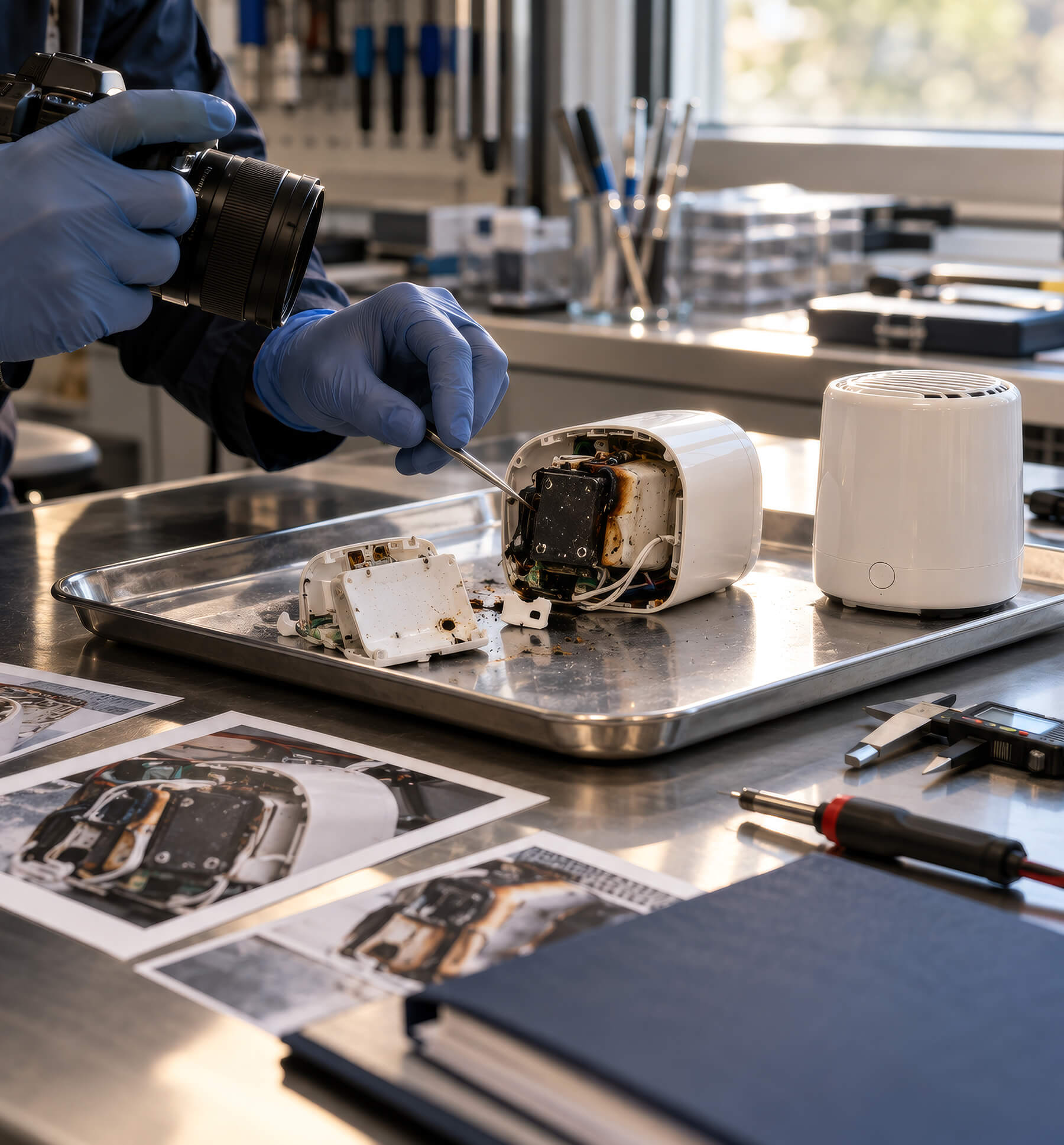
The CPSC reporting clock can start when someone at your company first receives information about a potential safety issue, not just when leadership first hears of it. “Immediately” means a company may have to report to CPSC within 24 hours of getting information. Get advice promptly on your company’s potential duty to report to CPSC. Pull your crisis team together to manage regulatory obligations, and challenging customer, retailer and social media communications.
You Do Not Need to Know the Cause Before You Call
In the middle of a crisis, you don’t have the luxury of waiting to have all the information before making a decision. We help you separate facts from possibilities, preserve the evidence, and develop the plan to work through the legal and technical questions as they arise. You may not know the precise failure mode yet, but you already have a long list of critical decisions in front of you right now.
Which Product Safety Crisis Are You Facing?
01
A product overheated, smoked, or caught fire.
Fire and burn reports draw close CPSC attention, even if no one was hurt.
02
Someone was injured.
03
A manufacturing error surfaced.
A bad component, a manufacturing error, or supplier change can create risk even when the design is sound.
04
A product failed a mandatory test.
05
A retailer or marketplace pulled the product.
Platforms and retailers act on their own timelines, and their action is safety information you must evaluate.
06
A SaferProducts.gov report names your product.
Do You Have to Report a Product Safety Crisis to the CPSC?
A report is not an admission that your company’s product is defective or that a recall is necessary. CPSC’s regulation (16 CFR 1115.12(a)) lets a company report without admitting that the information is reportable or that a safety or compliance issue exists. But failing to report or reporting late can carry serious consequences for a company.
Under Section 15(b) of the Consumer Product Safety Act, manufacturers, importers, distributors, and retailers must report within 24 hours when they obtain information that reasonably supports the conclusion that a product:
- fails to comply with a CPSC rule, regulation, standard, or ban;
- fails to comply with a voluntary standard CPSC has relied on;
- contains a defect that could create a substantial product hazard; or
- creates an unreasonable risk of serious injury or death.
A potential safety or compliance issue may be enough to trigger a reporting obligation. An injury is not required. If the information is not clearly reportable, a company may conduct a prompt investigation, generally no more than 10 working days. CPSC’s advice is “when in doubt, report.”
Five Questions We Answer With You
01
What happened?
We establish the product, model, lot, dates, conditions of use, affected population and reported injury. We also help you look beyond the first incident to investigate whether there are other relevant complaints, returns, warranty claims, or test results.
02
Why did it happen?
An incident does not always reveal the root cause. When needed, we bring in top-tier failure analysis engineers and testing experts, retained through counsel, to conduct a thorough root cause analysis.
03
Could it happen again?
04
What Does the Law Require in a Product Safety Crisis?
05
What path protects your customers, brand, and relationships?
If reporting is required, we help evaluate whether corrective action is appropriate. We craft a report to CPSC that advocates for your preferred solution. We coordinate retailers, marketplaces, suppliers, licensors, and insurers so everyone is on the same page, and bring in experienced PR and other professionals when needed.
If You Need to Report, What Happens Next?
Reporting to CPSC and recalling a product are separate decisions. We help you describe the information accurately, identify what remains under investigation, and evaluate whether corrective action is appropriate.
01
A regulatory issue.
A test or compliance review may indicate that the product does not meet a specific CPSC-enforced requirement. We examine the requirement, validate the result, identify the affected units, and assess the reporting obligation and safety risk.
03
Standard review.
CPSC staff evaluate the report. Many require no corrective action. If CPSC seeks corrective action, we help address and focus the scope, requested remedy, and consumer-facing communications.
02
A potential hazard.
The key issue is whether the product could create a substantial product hazard. You can (and often should) report while continuing to investigate and developing your own engineering analysis and risk assessment. Reporting does not mean you concede the existence of a defect or risk.
04
Fast Track recall.
A Fast Track recall is a quicker and often cheaper path to announcing a recall. If your company is ready to recall, it must institute a stop sale and distribution and have an acceptable corrective action plan ready to implement within 20 working days of filing the Fast Track report. We are always in the process of helping clients work through the Fast Track program, and we understand its nuances and keep tabs on policy changes affecting it.
24 hours
You may need to report to CPSC within 24 hours of possessing information that reasonably supports a reportable conclusion.
20 working days
To be eligible for a Fast Track recall, a company must be ready to implement an acceptable corrective action plan within 20 working days of filing its Fast Track report.
If companies want to conduct a Fast Track recall, they must select this option when submitting their first report. The Fast Track window does not extend the reporting deadline.
Why CPSC Experience Matters in a Product Safety Crisis
The first decisions in a product safety crisis are made before the facts are complete. Knowing how agency staff review incident histories, reporting timelines, and proposed corrective actions helps to better protect the company, its customers, and its business relationships.

Neal Cohen

Product Safety Crisis FAQs
Our consumer product broke, malfunctioned, overheated, caught fire, or experienced another product failure. What should our company do first?
You want to do the right thing to learn more about the reported incident as soon as possible. But you also want to act wisely. This is a situation when having a product safety attorney on your side is valuable. We will help you gather the necessary information and develop the best way to approach the consumer who is alleging the harm. Always make sure that your team avoids making any statements to customers or emailing different hypotheses internally about the cause until you better understand the facts. Of course, you want to recover and preserve the unit and save all related communication but you must be careful to move deliberately. Your engineers may want to start taking the product apart immediately but that may not be the right approach in a situation. Good intentions can often result in misunderstandings later after the dust has settled.
We received a report about our product allegedly breaking, malfunctioning, overheating, etc., but nobody was injured. Do we still have to report it to CPSC?
Possibly. It depends on many factors. An injury is not required to trigger a Section 15(b) reporting duty. A “near miss” or a choking incident can still reasonably support a conclusion that a product could create a substantial product hazard or an unreasonable risk of serious injury. So could a report of a fire where there is no property damage. We recommend that you retain a product safety attorney to help you move quickly (but carefully and deliberately) to gather the evidence, conduct an investigation, and ultimately assess whether there is a pattern or issue that could require further escalation and reporting.
A customer was injured when our consumer product failed. Does one incident require a CPSC report? Does a single incident trigger a Health Canada report?
A single incident is not automatically reportable to the CPSC. But there is no general one-incident exemption either. It depends on many factors, including the severity, the circumstances, whether the injury resulted from foreseeable use or misuse. A single incident may trigger a duty to report.
In Canada, however, there is a stricter requirement and a single incident more likely triggers a duty to file a Section 14(2) incident report with Health Canada under the Canada Consumer Product Safety Act (CCPSA).
In the U.S., it depends on many factors. For example, CPSC presumes an injury is serious in circumstances including a fracture, a laceration requiring sutures, a concussion, or hospitalization requiring medical or surgical treatment. Injuries to babies, children, the elderly, or other vulnerable and sensitive populations require extra care. How the product was used, prior complaints, and the risk to other users all matter.
My company received a negative product review or customer service call alleging a safety concern. Can you help?
Yes. We routinely help companies address reports of safety concerns, whether found in a review, a warranty claim, a customer service call, social media, or elsewhere.
When a consumer alleges a safety concern about your company’s product, such reports can sometimes be valuable and can help you make appropriate changes to mitigate the risk. These reports may even lead to an obligation to inform the CPSC, especially in case of serious injuries or reported deaths.
Other times, these consumer reports can prove … less helpful and require careful consideration on if, when, whether, and how to respond. We have helped thousands of companies through difficult moments with true product safety emergencies and also with truly difficult consumers.
Beyond concerns about lawsuits and liability, these responses can also have a direct effect on potential regulatory obligations. Consumers can (and do) threaten to inform the CPSC in some cases where their demands are not met. Sometimes their concerns are valid and important and must be addressed at the regulatory level. However your company elects to respond (and especially what you put into writing) should be carefully reviewed by a trusted advisor before being posted in haste.
My company is on the receiving end of a social media campaign. How can you help?
Social media campaigns, especially when they make allegations about your product’s safety, can quickly spin out of control. Like anything, acting early is key. It’s important to know when to engage, how to engage, and, sometimes, when not to engage.
Having dealt with some of the largest and major national and international recalls for tens of millions of units, we know a thing or two about crisis communications and responses. The major news outlets have all covered recalls and other crises that we have worked on. We have extensive experience working on company messaging that is persuasive, defensible, and effective. When we need to, we bring in outside communications consultants to deliver your message to the press.
How soon must a company report a potentially unsafe consumer product to CPSC under Section 15(b)?
A Section 15(b) report is due within 24 hours of obtaining information that reasonably supports a reportable conclusion. If the information is not clearly reportable, a company may investigate for a reasonable time, generally no more than 10 working days. That period is not an automatic waiting period. CPSC’s standing advice is “When in doubt, report.”
How soon must a company report a potentially unsafe consumer product to Health Canada under Section 14?
A Section 14(2) report is a mandatory preliminary report that must be submitted to Health Canada within 2 days (48 hours) after a company becomes aware of a health or safety incident involving a consumer product such as:
(a) an occurrence in Canada or elsewhere that resulted or may reasonably have been expected to result in an individual’s death or in serious adverse effects on their health, including a serious injury;
(b) a defect or characteristic that may reasonably be expected to result in an individual’s death or in serious adverse effects on their health, including a serious injury;
(c) incorrect or insufficient information on a label or in instructions — or the lack of a label or instructions — that may reasonably be expected to result in an individual’s death or in serious adverse effects on their health, including a serious injury; or
(d) a recall or measure that is initiated for human health or safety reasons in another country or jurisdiction.
If the incident occurred outside of the United States or Canada, is it still mandatory to report it to the CPSC and/or Health Canada?
The CPSC’s regulation requires that companies consider incidents that occurred in foreign jurisdictions for purposes of evaluating whether a company has a Section 15(b) duty to report. See 16 C.F.R. § 1115.12(f).
In Canada, the Canada Consumer Product Safety Act law itself requires reporting a section 14(2) incident to Health Canada for an incident that occurred outside of Canada if the product being sold was the same.
If we file a Section 15(b) report about a product safety concern, are we admitting a defect or agreeing to a recall?
Our product may have a potential issue that could cause an injury, but we are still investigating. Should we stop selling it now?
Whether to stop selling the product depends on the immediate risk, the information available, and how many units are still in distribution. A serious potential hazard may call for a prompt stop to sales. But a stop sale must be carefully considered as it may have other regulatory consequences. The decision should be deliberate, documented, and, ideally, undertaken with help from a qualified attorney or expert.
Companies that decide to voluntarily recall a product via the CPSC’s Fast Track program must stop sale as a condition of participating in that program.
When is a CPSC Fast Track recall appropriate after a product safety incident?
Fast Track is a CPSC program for companies who recognize that the product will need to be voluntarily recalled and where the company is prepared to move quickly to implement an acceptable consumer-level recall after finalizing their report. Where the program’s requirements are met, the company benefits as CPSC staff do not make a preliminary determination that the product presents a substantial product hazard. The program saves time, and reduces bureaucracy and cost, but commits you to a public recall, so it is only the right choice when the company has already determined that a public-facing voluntary recall is the right decision. Where possible, the Fast Track approach is recognized as a good one by companies; approximately 75% of CPSC recalls conducted annually are Fast Track recalls.
What penalties can our company face for failing to report a potentially hazardous consumer product to CPSC?
Failing to report can result in civil penalties of up to $120,000 per violation and up to $17,150,000 for a related series of violations. In 2026, CPSC announced settlements resolving late-reporting charges involving Clorox ($14.15 million), Johnson Health Tech ($16.875 million), and Daikin ($8.5 million). Knowing and willful violations can also lead to criminal prosecution against companies and individual officers.
A consumer reported an incident involving our product on SaferProducts.gov. How can our company respond?
CPSC sends the report to the manufacturer and generally publishes it as soon as practicable, but no later than the 10th business day after sending it, subject to regulatory exceptions.
We can help you review the consumer claim, prepare a comment to submit for publication with the report and/or challenge materially inaccurate or confidential information. It is important to take care when drafting a public-facing response. The consumer who filed the report will receive a copy of your response, as well.
Amazon or a retailer knows about a safety incident involving our product. Do we still have to report to CPSC?
It depends. If the marketplace or retailer reported to CPSC, it may satisfy your requirements, but you will want to be certain of this. Retailers and marketplaces tend to have less information about a product than you do so their report to the CPSC may not be sufficient to relieve you of your own duty to the CPSC. The facts of each circumstance are different and need to be examined.
Manufacturers, importers, distributors, and retailers each carry their own reporting duty. Your obligation is not satisfied until your company reports or has actual knowledge that CPSC has been adequately informed by another responsible party.
Should we retain engineers or testing labs through counsel when investigating a possible product safety hazard?
In a product safety investigation, it is often better to retain technical experts through counsel, with a written engagement that states the legal purpose. Because we are retained to provide you with legal advice about your potential legal obligations, having an attorney-led investigation with a qualified expert may help to properly characterize the work as attorney-work product if an attorney deems it necessary to provide legal guidance. The potential for this work to qualify as attorney work product is not absolute but having an attorney lead the investigation helps to provide at least an initial presumption of work product protections.