
Received a CPSC Notice of Violation?
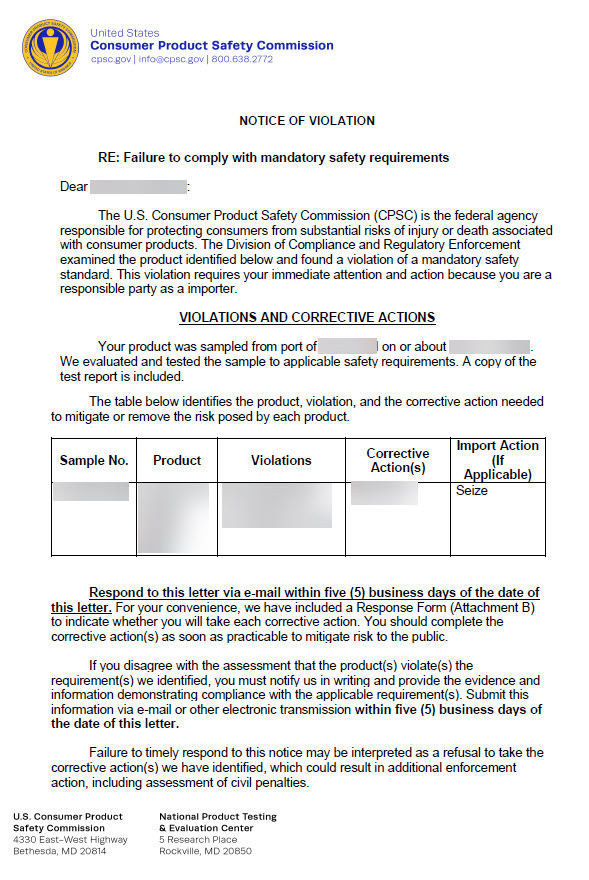
A CPSC Notice of Violation, often called an NOV, is not simply a request for information. The agency is telling you it believes your product is not in compliance with a mandatory federal product safety requirement. The CPSC is also identifying the corrective action it expects you to take.
You must take this NOV seriously. But do not just assume that CPSC’s first position in this NOV will be their final conclusion. Effective advocacy helps to ensure that the CPSC has the best understanding of the facts and may help protect your products from being seized by the U.S. government. For instance:
- Does the alleged violation actually apply to your product?
- Which model, lot, or production version did CPSC evaluate?
- How many units are actually affected?
- Does the issue require a product recall or that the products be seized and destroyed by the government?
These questions should be addressed before your company sends its first substantive response.
Neal Cohen and Boaz Green are former CPSC attorneys. They worked inside the agency and now represent manufacturers, importers, retailers, brands, and marketplace sellers in effectively dealing with CPSC compliance and enforcement matters.
WHAT DOES IT MEAN?
What Is a CPSC Notice of Violation?
A CPSC Notice of Violation (NOV) is an enforcement communication from the U.S. Consumer Product Safety Commission identifying a requirement the agency believes your product violated and the corrective action CPSC considers appropriate.
NOVs may involve requirements enforced under the Consumer Product Safety Act and other statutes CPSC administers, including Reese’s Law, the Federal Hazardous Substances Act and the Flammable Fabrics Act. The alleged violation may involve mandatory safety testing or certification, labeling or warnings, tracking information, product construction, packaging, or another federal product safety requirement. It may also involve a failure to properly eFile a certificate of compliance.
NOVs can arise from different types of compliance activities. The most common are market surveillance where CPSC purchases and tests consumer products and port inspections, when CPSC’s Office of Import Surveillance works with U.S. Customs and Border Protection to identify and examine imported shipments.
Receiving an NOV does not mean every factual, technical, or legal question has been fully considered yet. It also does not necessarily mean that your product will be recalled or seized and destroyed at the port.
WHAT KIND OF LETTER DID YOU RECEIVE?
Notice of Violation vs. Section 15(b) Report Request
Notice of Violation: CPSC has identified what it believes is a violation and is seeking corrective action.
Section 15(b) Letter: CPSC is investigating whether your product presents a substantial product hazard or a regulatory violation.
5 Steps to Take After Receiving an NOV
Preserve the Product.
Do not repair, relabel, discard, or modify the units at issue before you understand what CPSC evaluated. If the product changed over time, preserve examples of the relevant versions.
Preserve the Record.
Gather the Notice of Violation, test reports, CPCs or GCCs, packaging, instructions, drawings, supplier communications, manufacturing records, import records, complaints, sales data, and relevant marketplace correspondence.
Identify the Actual Affected Population.
Pull model numbers, SKUs, ASINs, production dates, import dates, lot codes, factories, suppliers, components, and sales data to determine which units actually share the alleged issue that CPSC identified. Further analysis will be needed to address CPSC's claims.
Centralize Communications.
Your compliance team, executives, factory, laboratory, insurer, marketplace team, retailers, and outside vendors should not independently create competing explanations of what happened. You should have one point person to develop a clear and accurate timeline and a coordinated response.
Review Deadlines.
NOVs typically require responses within five or ten days.
If you do not respond, CPSC will take action, and your products may be seized and destroyed.
Why a Former CPSC Insider Matters Here
The CPSC is a small agency. How a matter is handled often depends on how it is framed and presented to staff and which arguments are the most persuasive to the CPSC. Neal Cohen served as the Small Business Ombudsman at the CPSC from 2010 to 2016 and as Chief Counsel to the Director of the Office of Compliance. Boaz Green served as Chief Counsel to a CPSC Commissioner. We have sat on the other side of the conference table and we understand what the government is thinking and what it may want. We bring our unique perspective and skill set to navigating the details involved in your case and the nuances of any negotiation with the government.

Neal Cohen

CPSC letters have short deadlines. Don’t let the clock run.
CPSC Notice of Violation FAQs
What is a CPSC Notice of Violation?
A CPSC Notice of Violation (NOV) is a formal communication from the U.S. Consumer Product Safety Commission stating that the agency believes a product violates a federal product safety requirement under the Consumer Product Safety Act or another statute the CPSC administers, such as the Federal Hazardous Substances Act or the Flammable Fabrics Act. The notice identifies the alleged violation and the corrective action that CPSC considers appropriate and demands information about the product, sales, and incidents. CPSC is entitled to these responses under federal law. The NOV is an enforcement communication and should be reviewed promptly. Receiving an NOV does not automatically mean your product is violative, but it does mean that you must provide a response to the CPSC. We help you frame and present the facts in your response back to the agency in a manner that CPSC is most likely to find persuasive.
What should I do after receiving a CPSC Notice of Violation?
Review the notice and the deadline to respond to CPSC, which is typically five or ten days. Preserve the product and all relevant records, determine exactly which product CPSC evaluated, and identify the potentially affected models, lots, or production periods. Before sending a substantive response or agreeing to corrective action, seek professional guidance to help you understand what CPSC evaluated and the options available to your company. Even an initial explanation that seems harmless and is provided to the agency early in an investigation can cause trouble later.
How quickly do I have to respond to a CPSC Notice of Violation?
The deadline provided by CPSC is usually five or ten days.
If you do not respond, you lose the chance to advocate for your product. CPSC will often proceed with the corrective actions referenced, which can include seizure and destruction of imported product or a unilateral product safety warning.
Does a CPSC Notice of Violation mean I have to recall my product?
Not necessarily. A recall is one possible outcome, but there are also other potential outcomes.
Depending on the issue and the facts, a successful outcome may involve demonstrating that the products already comply or providing CPSC with additional testing, correcting certification documents, revising labels or warnings, reworking inventory, and/or correcting future production.
Can I challenge aspects of a CPSC Notice of Violation?
Yes, aspects of an NOV can be examined and challenged. CPSC’s product identification, testing, sampling, application of the relevant requirement, affected product population, and proposed corrective action can all warrant careful review. Depending on the facts, company testing, technical evidence, compliance records, or legal analysis may support a different conclusion or a narrower corrective action.
What is the difference between a Notice of Violation and a CPSC 15(b) letter?
Notice of Violation: CPSC has identified what it believes is a violation and is seeking corrective action.
Section 15(b) Letter: CPSC is investigating whether your product presents a substantial product hazard or a regulatory violation.
I received an NOV for a product that I sell through a marketplace. Will the marketplace take action?
Most likely yes. CPSC usually copies the marketplace when it issues an NOV for a product sold online. The marketplace will usually delist the product, and may freeze other listings or your funds until the issue is resolved. You will need to manage your relationship with the marketplace and keep them informed of the progress while also dealing with CPSC. When we help our clients resolve an NOV, we make sure to also preserve a good relationship with the marketplace or retailer.
Will I have to destroy my inventory?
Not necessarily. Depending on the circumstances, options may include reconditioning, relabeling, rework, correction of documentation, changes to future production, refusal of admission for imported products, recall, or other corrective action. What happens to inventory depends on the violation, product, location of the goods, and available corrective options.
My Notice of Violation came after a port detention. What happens now?
A CPSC port examination or detention can lead to a NOV if the agency concludes that the imported product fails to comply with an applicable requirement. The NOV and the status of the physical shipment need to be addressed together, because decisions concerning testing, reconditioning, release, refusal of admission, and other import consequences are all interrelated. See our Products Detained at Port page for the detention process in detail.
How can Neal Cohen Law help with a CPSC Notice of Violation?
We review the NOV and the CPSC’s stated basis for its finding, identify the applicable statute, regulation, standard, or other requirement, and evaluate the evidence against the agency’s position. That can include comparing CPSC’s testing with company or laboratory testing, determining whether CPSC evaluated the correct product or product version, reviewing CPCs, GCCs, test reports, labels, warnings, packaging, and technical files, and determining the actual affected product population. We coordinate with testing laboratories and technical experts where appropriate, prepare and communicate the company’s response to CPSC, and address related import, retailer, Amazon, and marketplace consequences.
Where corrective action is appropriate, Neal Cohen and Boaz Green help determine and negotiate its scope. Where the proposed scope is broader than the evidence supports, we help limit the scope of the agreed upon action with CPSC. Where a recall is warranted, we help negotiate the terms, including the affected population, recall remedy, implementation and timing, and all public-facing communications.
We are always committed to seeking the best possible outcome for our clients, based on the unique factual and legal details of each case.
Book an initial call directly with Neal Cohen Law.